
[PDF EBOOK EPUB] Mortal Republic: How Rome Fell into Tyranny
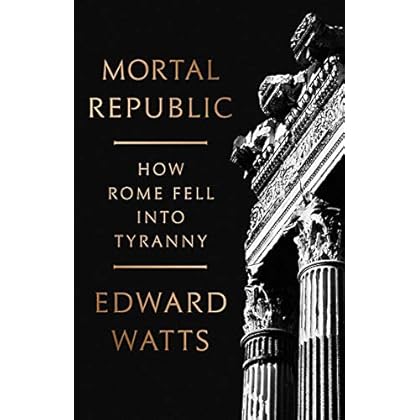
Description for Mortal Republic: How Rome Fell into Tyranny
Review '[An] incisive history...Watts describes how the rise of an economic �lite and increasing inequality brought about populist sentiment that was easily exploited by nefarious politicians. The parallels to the present day are striking.'?New Yorker'If the central analogy that animates Mortal Republic is correct, the current challenge to America's political system is likely to persist long after its present occupant has left the White House.'?New York Times Book Review (Editor's Choice)'Mortal Republic provides excellent insights into how the Republic became the Empire, and more broadly it speaks to the ever-present threat of centralized power. The more a civilization centralizes, the more powerful a central government becomes.'?New York Journal of Books'Watts chronicles the ways the republic, with a population once devoted to national service and personal honor, was torn to shreds by growing wealth inequality, partisan gridlock, political violence and pandering politicians, and argues that the people of Rome chose to let their democracy die by not protecting their political institutions, eventually turning to the perceived stability of an emperor instead of facing the continued violence of an unstable and degraded republic.'?Smithsonian'Readers will find many parallels to today's fraught political environment: the powerful influence of money in politics, a 'delegitimized establishment,' and 'the emergence of a personality-driven, populist politicking.' Watts ably and accessibly...covers a lot of ground in a manner accessible to all readers, including those with little knowledge of Roman history. This well-crafted analysis makes clear the subject matter's relevance to contemporary political conversations.'?Publishers Weekly'In a timely book of ancient history, an eminent classicist looks at Rome's decline from representative government to corrupt empire.... Given that mistrust of institutions is a key ingredient in the collapse of republican rule, as we are witnessing daily, the lesson is pointed. An engaging, accessible history that, read between the lines, offers commentary on today's events as well as those of two millennia past.'?Kirkus'Lucid, fast-paced, and well informed. Edward Watts's history of the failure of the Roman Republic is the tale of how greed and self-interest undermined the ancient world's most successful democratic superpower and caused Rome's people to vote in a dictatorship. Beginning with Rome's confrontations with Pyrrhus and Carthage, and a relatively simple state based on reasonable equity, Watts takes us into a world of the super-rich who undermined the very system that gave them their wealth, driving it downwards into civil war and mass murder. The elective tyranny of Augustus proved to be the only answer. This is both a splendid introduction to one of the most dramatic periods of history and a book for our times.'?David Potter, author of Constantine the Emperor'Mortal Republic retells the familiar story of how one of history's most famous and long-lived republics became a monarchy. Edward Watts is an expert and eloquent guide through the political drama of the late republic, and his book offers a timely reminder that constitutions are fragile and that the politics of consensus can be replaced by the politics of violence one small selfish act at a time.'?Kyle Harper, author of The Fate of Rome: Climate, Disease, and the End of an Empire Read more About the Author Edward J. Watts holds the Alkiviadis Vassiliadis endowed Chair and is professor of history at the University of California, San Diego. The author and editor of several prize-winning books, including The Final Pagan Generation, he lives in Carlsbad, California. Read more
Books are everywhere. Libraries big and small and bookstores are splattered all over college campuses and larger cities. They are all filled with one of the most important things of all time—books. Those who read books appreciate the multiple places to find books. Those who aren’t fans of books, don’t understand what could make readers want to obsess over books. There is a reason for their obsession, though. You hear it all the time: read every day.Reading is important because it develops our thoughts, gives us endless knowledge and lessons to read while keeping our minds active. Reading books to help us learn and understand and makes us smarter, not to mention the knowledge, vocabulary and thinking skills we develop.In the world today where information are abundant, reading books is one of the best ways to be informed. Though reading might seem like simple fun, it can be helping your body and mind without you even realising what is happening. What makes reading so important? It can be for these reasons and not just knowledge.For those who don’t enjoy it, you might change your mind after hearing about the benefits. Can something so easy and fun be so helpful in your life? Of course, it can! Reading can be a great benefit to you in many different ways—such as sharpening your mind, imagination, and writing skills. With so many advantages, it should be an everyday occurrence to read at least a little something.Books can hold and keep all kinds of information, stories, thoughts and feelings unlike anything else in this world. Can words, paragraphs, and fictional worlds be all that great for you and your health? It definitely can, and it is a timeless form of entertainment and information
Step-By Step To Download Mortal Republic: How Rome Fell into Tyranny
- Click The Button "DOWNLOAD" Or "READ ONLINE"
- Sign UP registration to access & UNLIMITED BOOKS
- DOWNLOAD as many books as you like (personal use)
- CANCEL the membership at ANY TIME if not satisfied
- Join Over 80.000 & Happy Readers.
OR


No comments:
Post a Comment